The Truth behind a global Staple
Ten Thousand Years of Four Ingredients
In the black basalt desert of eastern Jordan, archaeologists sifted through the ashes of a hearth and found something extraordinary: a flatbread, charred and crumbed, baked roughly 14,400 years ago — four thousand years before farming began. The Natufian people who made it had gathered wild einkorn, wild barley and club-rush tubers, ground them on stone, mixed them with water and cooked them on a hot rock.
That is bread. Not a category, not a brand, not a shelf-ready unit. Flour, water, heat, and a pair of hands.
For the next fourteen millennia the recipe barely changed. Egyptian bakers discovered that a wet dough left alone would rise on wild yeast and lactic acid bacteria, and built the first sourdough cultures. Roman armies marched on panis militaris. Medieval Europe organised itself around the communal oven, and the miller and the baker were civic institutions. Bread was the staff of life, and it was regulated, taxed, priced and fought over precisely because it mattered.
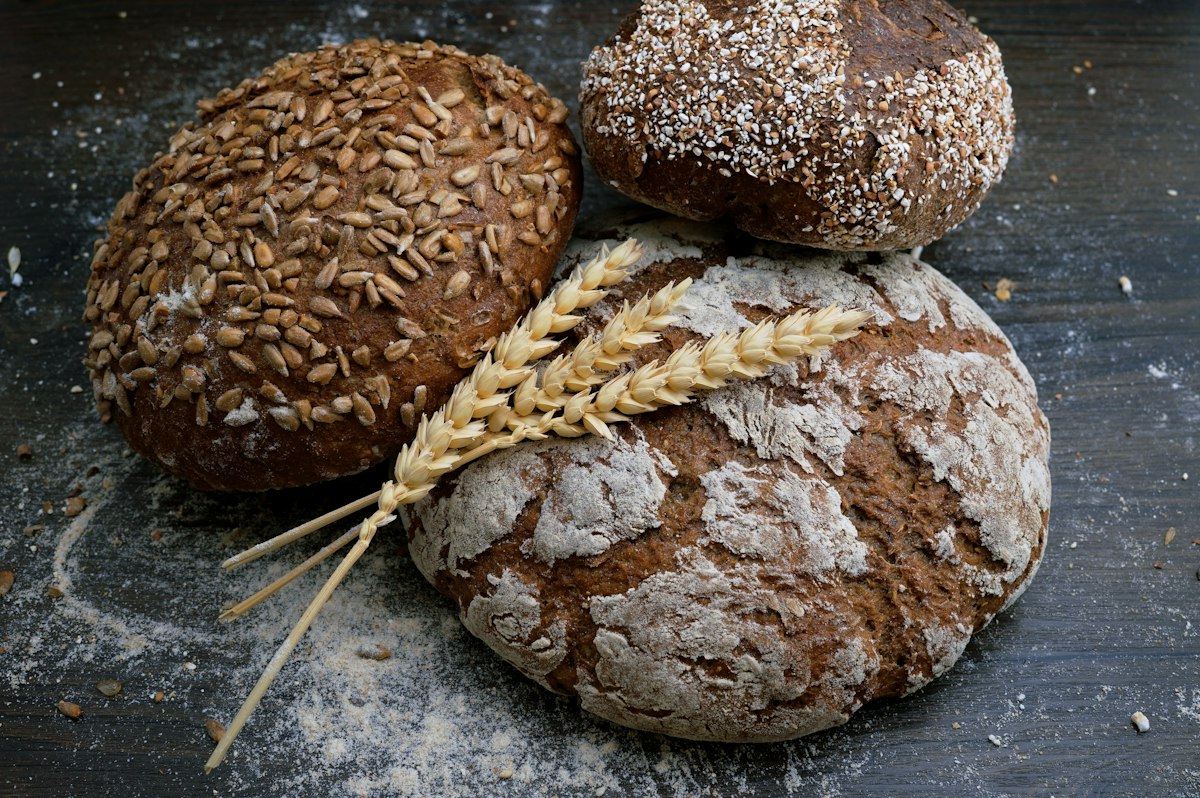
What mattered was that bread was fermented. A long, slow ferment does real work: it breaks down phytic acid so you can absorb the zinc, iron and magnesium in the grain; it pre-digests gluten and starch; it develops flavour no additive can imitate; and it produces acids that hold mould at bay without chemistry. Whole grain, stone milled, wild fermented, salted. Four ingredients and time.
1961: The Year Bread Stopped Being Bread
Then, in a research bakery in Chorleywood, Hertfordshire, the British Baking Industries Research Association did something that changed the loaf on every table in Britain.
The Chorleywood Bread Process, introduced in 1961, replaced fermentation with violence. Dough was mixed at high speed in a pressure-controlled chamber, forcing air in and developing the gluten mechanically in minutes rather than hours. Ascorbic acid and fat were added to compensate for what the process destroyed. Chemical improvers did the rest. It collapsed the production cycle from a day to a couple of hours, and it meant bakers could use cheap, low-protein British wheat instead of expensive imported Canadian grain. By the mid-1970s the process accounted for the overwhelming majority of industrial bread sold in the UK. It was exported to the United States, Australia and New Zealand, and it is still how most supermarket bread on both sides of the Atlantic is made.
Nobody asked whether the bread was better. They asked whether the bakery could make more of it, faster, for less.
The Margin Is the Point
Understand the economics and everything else follows.
A standard 800g supermarket white loaf sells for roughly £1.10 to £1.65 in the UK and $2 to $4 in the US. The wheat in it costs pennies: at bulk flour prices a loaf contains perhaps 15 to 25 pence worth of flour. Add a few pence of yeast, salt, improvers and energy, and a plastic bag. The result is one of the highest-margin items in the grocery basket — and one of the most powerful, because bread is what gets people through the door. It is a loss leader, a basket builder, a reason to drive to the shop.
Now look at what that margin buys you in return. Shelf life. A conventional industrial white loaf is engineered to stay soft and mould-free for five to seven days, sometimes longer, in modified-atmosphere packaging. A genuine sourdough made with nothing but flour, water and salt is at its best for two days and noticeably stale by three, although its acidity means it usually resists mould longer than its soft, sweet, chemically protected cousin.
The trade is explicit. Real bread is alive, so it dies. Industrial bread is embalmed, so it lasts. Every additive in the modern loaf exists to solve a problem created by making it quickly: conditioners to replace fermentation, emulsifiers to replace the crumb structure time would have built, preservatives to buy back the days that speed destroyed.
The Five Worst Things in a Modern Loaf
1. Calcium propionate (E282). The mould inhibitor. It is why a supermarket loaf can sit in a cupboard for a week without a single blue fleck. It is permitted, it is common, and it is a confession: the product needs an antifungal because it has no natural defence of its own.
2. Mono- and diglycerides of fatty acids (E471). Emulsifiers that keep the crumb soft and the loaf uniform. They are among the most studied additives of the past decade, and the research is not reassuring: emulsifiers have been shown to alter the gut microbiome and promote intestinal inflammation in laboratory and animal models. E471 also has a dirty little secret — it can be manufactured from trans fats, and it frequently contains them.
3. DATEM (E472e). A dough conditioner that strengthens gluten so a high-speed line can handle the dough without tearing it. It is also, absurdly, one of the additives most frequently found in gluten-free products. The Environmental Working Group flagged it among additives of concern, and in the EU it must now be shown to contain no more than trace trans fat.
4. L-cysteine (E920). A reducing agent that relaxes the dough so it can be machined. It is usually produced by hydrolysis of keratin — historically from human hair, more commonly now from duck feathers or synthetic fermentation. The EU banned hair-derived cysteine in 1996. Feather-derived material remains in use.
5. Azodicarbonamide (E927a) and potassium bromate. The two great flour improvers. Azodicarbonamide, the yoga mat chemical, is banned in the EU, the UK and Australia and was removed from Subway's bread in 2014 after a public campaign; it remains legal in the United States at up to 45 parts per million. Potassium bromate is classified as a possible human carcinogen, is banned across the EU, the UK, Canada, China and Brazil, and requires a cancer warning in California; it is still permitted in American flour. Two chemicals Britain will not allow in food are legally in the loaf sold to American families.
Add the residue question. Conventional wheat is frequently desiccated with glyphosate shortly before harvest to even out ripening, and traces survive milling. Organic grain cannot be treated that way.
The Organic Myth
Here is where the health halo does its best work.
Organic is a statement about how the wheat was grown. It is not a statement about how the loaf was made. A supermarket organic wholemeal loaf can be manufactured on exactly the same Chorleywood line, at exactly the same speed, with exactly the same improvers as the conventional one beside it — and it frequently is. Certification restricts certain additives, but it does not require fermentation, does not forbid high-speed mixing, and does not require the loaf to be made of anything other than fast dough.
Worse, the label hides most of what you would want to know. Under UK and EU rules, processing aids and enzymes — amylase, xylanase, lipase, oxidases — do not have to be declared on an ingredients list at all. A loaf can read organic wholemeal wheat flour, water, sea salt, yeast and still contain a cocktail of enzymes, ascorbic acid and emulsifier carriers used to fake the qualities fermentation used to provide. The list is legally true and functionally incomplete.
And the premium is enormous. Organic bread routinely sells for £3 to £4.50 a loaf, three times the price of the white sliced next to it, for a product whose ingredient cost has risen by perhaps fifteen pence.
Organic is not nothing. It means fewer pesticide residues, no glyphosate desiccation, and stricter rules on what may be added. But it is not a synonym for real bread, and the industry knows it.
The Gluten-Free Illusion
Now consider the strangest product in the aisle: gluten-free bread that stays edible for weeks in an airtight plastic packet on a shelf.
That is not a triumph of baking. It is a triumph of chemistry and packaging. Gluten is the structure of bread; remove it and you must replace it with something. Industrial gluten-free loaves are built from rice starch, tapioca starch, potato starch and maize, glued together with xanthan gum (E415) or hydroxypropyl methylcellulose (E464), sweetened with syrups, softened with glycerine, then preserved and gas-flushed so they can survive a distribution chain measured in months rather than days. Nutritionally they are usually worse than the bread they replace: higher in sugar, fat and salt, lower in fibre and protein, with a sharper glycaemic response. For people with coeliac disease they are a medical necessity. For everyone else they are a premium-priced ultra-processed product wearing a health halo.
Real gluten-free bread exists: buckwheat, sorghum, teff and rice sourdoughs, fermented slowly, sold fresh, stale in two days. It tastes like bread. It behaves like bread. It simply does not last.
Real Bread, One Tin, One Afternoon
This is the whole recipe. It costs about 60 pence to make.
- 500g stoneground organic wholemeal flour
- 400g lukewarm water
- 10g ground Celtic salt
- 100g active sourdough starter (or 7g dried yeast plus a 12-hour cold prove)
Use ground Celtic salt if you can. Grey, slightly damp and still carrying its trace minerals, it is the best salt you can put in a loaf, and it dissolves into the dough without the harsh edge of refined table salt.
Mix the flour with 350g of the water and leave for 30 minutes. Add the starter, the salt and the remaining water, and squeeze it through your fingers until no dry flour remains. Cover and rest for 30 minutes, then give the dough four sets of stretch-and-folds, 30 minutes apart. Shape it into a lined tin and prove until it has risen by half again — three to five hours in a warm kitchen, or overnight in the fridge. Bake at 230°C for 20 minutes, then at 200°C for a further 25. It is done when the internal temperature passes 96°C and the loaf sounds hollow. Cool it completely on a rack before cutting, or you will ruin the crumb you spent a day building.
Wholemeal needs the extra water and the long ferment. Give it both and it will beat anything you can buy.
Five Stoneground Flours Worth Buying
UK
- Shipton Mill Organic Stoneground Wholemeal (Tetbury, Gloucestershire). French burr stones, certified organic, and one of the few mills still grinding slowly enough to keep the wheatgerm oil intact.
- Stoate & Sons Organic Stoneground Wholemeal (Cann Mills, Dorset). A family mill grinding stoneground flour since the 1880s, using British organic wheat.
- Doves Farm Organic Wholemeal Bread Flour (Hungerford, Berkshire). Widely stocked, reliably organic, and milled in Britain rather than imported.
USA
- Central Milling Organic Stoneground Whole Wheat (Logan, Utah). Bakery-grade, organic and stoneground — the standard against which most American wholemeal is measured.
- Hayden Flour Mills Stoneground Whole Wheat (Queen Creek, Arizona). Heritage grains, stoneground in small batches, with the flavour that reminds you wheat used to taste of something.
One loaf, four ingredients, a few hours. The bread on your table has been industrialised for sixty years. It takes an afternoon to take it back.