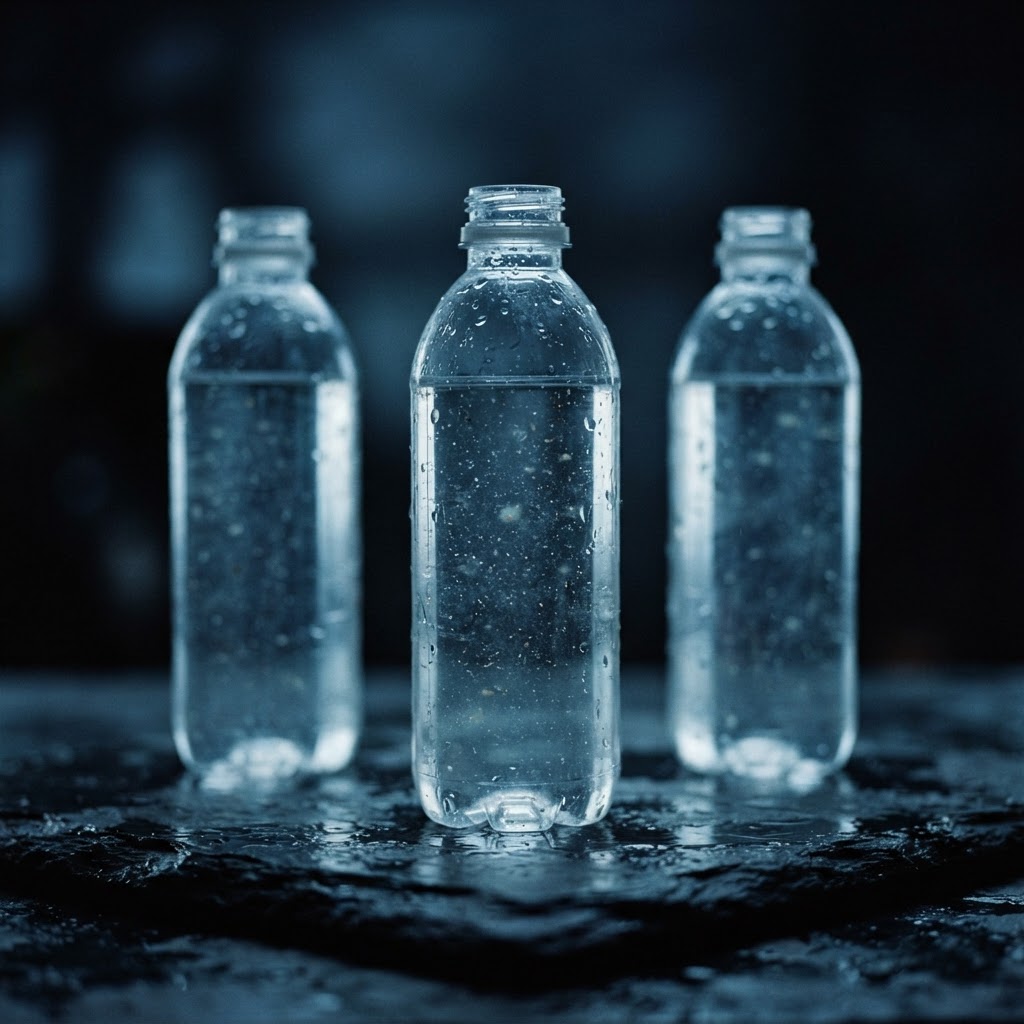
In 2018, a team of researchers bought 259 bottles of water — eleven brands, nine countries — and put every one of them under a microscope. Ninety-three per cent came back carrying plastic. The industry's reply was immediate and predictable: bad methodology, contaminated samples, a scare story. Six years later, a team at Columbia University went looking for particles a hundred times smaller, using a technique that did not exist when the first study was published. They found an average of 240,000 plastic fragments in every single litre.
Read that number again. Not per bottle drunk over a lifetime. Per litre. Per day, if you are a person who has decided that the safest water is the water in the bottle.
The Studies the Industry Would Rather You Forgot
The 2018 investigation, led by Sherri Mason at SUNY Fredonia for Orb Media, tested bottles including Nestlé Pure Life, Evian, Fiji and San Pellegrino, bought in nine countries. It found an average of 10.4 plastic particles per litre above 100 microns — roughly double the contamination found in the same team's tap water samples. Sixty-five per cent of what they found were fragments, and the polymers were largely the polymers of the bottle and the cap. The packaging was in the product.
Then came the 2024 Columbia study, published in the Proceedings of the National Academy of Sciences. Three popular brands, seven polymer types identified, and by far the dominant finding was not the microplastics everyone argues about but nanoplastics — particles under a micron, small enough to cross a cell membrane, small enough that your gut does not recognise them as a foreign object. Ninety per cent of the 240,000 particles per litre were nanoplastics. Previous studies had counted the plastic they could see. This one counted the plastic that can see you.
Volvic, Danone's other flagship, is not in that study — but it makes the same promise in the same material, and nothing about the promise has changed since the testing began. "Naturally filtered through volcanic rock" describes the journey. It does not describe the destination, which is a PET bottle.
Why the Science Is Not Guessing
The industry's defence has always been the same three moves, and all three are now failing.
First: "the samples were contaminated." This was a fair criticism in 2018, and it is precisely why the field rebuilt itself around process blanks, positive controls, filtered air and lab clothing made of natural fibres. The Columbia team used stimulated Raman scattering microscopy, which identifies the polymer of an individual particle rather than guessing from its appearance. When you can name the plastic, you cannot be accused of mistaking dust for polyethylene.
Second: "we cannot find it." That argument is only ever a statement about the detection limit. We could not find PFAS in blood in 2001 either. We now find it in 97% of Americans. We could not measure lead at micrograms per decilitre, and then we could, and the entire notion of a "safe" threshold collapsed. Absence of evidence at yesterday's resolution is not evidence of safety at today's.
Third: "the dose makes the poison." True, and useless as stated, because nobody has established the dose. The World Health Organization's 2019 review concluded that microplastics in drinking water were unlikely to pose a risk at current levels — while explicitly saying its confidence was low because the data did not exist. That is not a clean bill of health. That is a request for more research, quoted ever since as though it were an acquittal.
What Happens After You Swallow
Here is where the argument stops being theoretical.
In March 2024, the New England Journal of Medicine published a study of 257 patients undergoing surgery to clear their carotid arteries. Microplastics — polyethylene, specifically — were found inside the plaque itself in 58% of them. Over the following three years, those patients were 4.5 times more likely to suffer a heart attack, stroke or death than those whose plaques were clean. That is not a correlation between drinking bottled water and feeling tired. That is plastic lodged in human arterial disease, with an outcome signal attached.
In 2025, a Nature Medicine paper reported that the median human brain now contains roughly half a per cent plastic by weight, and that the brains of people who died with dementia carried three to five times more. The particles were nanoplastics, and the paper's most unsettling finding was not the quantity but the composition: the polymer profile of the brain matched the polymer profile of the environment.
We also know what comes with the plastic. PET manufacture requires antimony, and antimony migrates into water — faster when the bottle is warm, faster still in sunlight. Polycarbonate food containers are built on bisphenol A, whose tolerable daily intake the European Food Safety Authority cut in 2023 by roughly twenty thousand fold on the basis of immune effects in humans, and which the EU has since banned from food contact materials outright. Soft plastics are softened with phthalates, the most studied endocrine disruptors in existence, and the ones most reliably found in the urine of children.
Your Kitchen Is the Same Chemistry, One Degree Hotter
Bottled water is the most conspicuous example, not the only one.
Plastic food boxes. "Microwave safe" means the box survives the microwave. It does not mean nothing migrates out of it. Heat, fat and acid are the three accelerants of chemical migration, and a reheated curry in a polypropylene tub is all three at once. Polycarbonate — the clear, hard plastic of older food containers and water coolers — is the one that leaches bisphenol A. Soft lids and cling films are where the phthalates are. The honest test is not whether the container deformed. It is whether you would still eat from it if you could see what entered the food.
Cellophane and the films sold as plastic-free. Real cellophane is regenerated cellulose: it is genuinely compostable, and genuinely not the problem. The problem is that almost nothing sold as cellophane film is only cellulose — it is cellulose coated with nitrocellulose or polyvinylidene chloride (PVdC) to make it heat-seal and hold moisture. PVdC is a chlorinated plastic. It does not compost. And "compostable" PLA films need industrial conditions that no domestic bin provides. The packaging is doing what packaging does: it is performing a story.
Silicone. Silicone is the least-bad of the flexible options, and it is not inert. Cheap silicone is cut with fillers — often silica, sometimes worse — and at oven temperatures silicone releases siloxanes (D3 to D6) into food, with the highest migration into fatty foods at high heat. Europe has already restricted D4 and D5 as substances of very high concern. A silicone muffin mould is fine for a low-fat bake. It is not a stainless steel pan, and it should not be treated as one.
The alternatives are old, boring and settled: glass, stainless steel, unlined steel, ceramic. Materials with a thousand-year safety record do not need a marketing campaign.
The Claim That Is Coming
So where is the litigation? The wiki lists the bottled water microplastics case as pending, no judgments yet — and that is exactly right. Nobody has won it yet. Here is what the claim will actually look like, and why it is not frivolous.
It will not be framed as "plastic poisoned me." That case requires proof of a specific dose causing a specific injury, and the exposure science is not there. It will be framed the way every successful consumer claim of the last decade has been framed:
- Breach of implied warranty and merchantability — the product is sold as water. Water plus 240,000 particles of polymer is not the thing contracted for.
- Failure to warn — the same theory that built the Zantac and talc litigation. You cannot market absolute purity and stay silent about contamination you could have measured.
- Consumer protection and deceptive marketing — "natural", "pure", "untouched", "mountain", "volcanic" — language that is materially misleading when the delivery mechanism is the contamination. This is the PFAS playbook: 3M's $10.3 billion settlement did not require proving anybody's cancer. It required proving contamination and concealment at scale.
- Proposition 65-style exposure warnings in California, where a listed chemical in a consumer product does not need a body count to trigger a claim.
The reason it has not landed is not that the science is weak. It is that the science has not yet produced the one thing litigation needs: a biomarker. The moment a validated blood or tissue measure of nanoplastic burden is tied to a clinical endpoint — and the carotid artery data above is one endpoint away from that — the first plaintiff with a measurable body burden and a clean causation expert changes the entire market. Watch what Arizona did to L'Oréal over hair relaxers: a state attorney general, a marketing claim, and no need to prove a single individual's cancer.
What To Do Tonight
Stop buying water in single-use plastic. Not because you will certainly be harmed by Thursday — because it is the cheapest, easiest reduction in your body's plastic load, and the burden of proof has quietly shifted. Buy glass or stainless steel. Filter your tap water and carry it in metal. Never heat food in plastic, never store fat or acid in it, and treat "BPA-free" as the marketing it is: a swap to BPS, a chemical nobody has cleared either. Buy food in glass where you can. Avoid PVdC-coated films. Keep silicone for low heat.
You are not being asked to believe a scare story. You are being asked to notice something absurd: that the water you pay four pounds a litre for arrives in the one material that nobody has ever demonstrated is safe to drink from — and that the industry's own testing, published in peer-reviewed journals, already shows the packaging is in the product.
The court case has not been won. The evidence has been gathered.